Marketing stands at an inflection point. Artificial intelligence could be a catalyst to accelerate growth or quietly undermine it. The same technology that unlocks new sources of creativity and innovation can also pose a fundamental risk—a narrow focus on productivity that could shrink budgets, erode marketing’s influence and limit its impact on enterprise value. How CMOs drive the AI agenda will determine whether marketing is reduced to a cost to be contained or elevated as a force multiplier for enterprise growth.

Our new research with the Association of National Advertisers (ANA) shows that leading marketers deliver 79% greater total shareholder value than their peers—and, for the first time, we can show why. Our findings are grounded in thousands of historical data points of industry leaders across 11 sectors as well as interviews with more than 30 CMOs and CFOs that provide evidence linking creativity, brand strength and financial performance.
The findings send a clear message. Used narrowly, AI can make marketing less expensive—faster content, smaller budgets, leaner teams. Used strategically, it can make marketing indispensable—unlocking new growth, higher profitability, greater enterprise value.
As the CMO of a leading consumer packaged goods company said, “AI should be seen through a growth lens, not an efficiency lens. ... The future will honor the brave who use it to create, not just optimize.” Another clear finding in our data analysis: When AI is used for more than just increasing speed and reducing costs, companies can unlock more than two times higher marketing-driven profitability. The real value comes from elevating the work—being more creative, more relevant and more connected to growth. That requires intent, a clear strategy and bold leadership from marketing.
To realize the full dividend from AI, marketing leaders should focus on three things—evidence that demonstrates marketing’s role in value creation, alliances across the C-suite that build trust by showing how marketing drives business growth, and leadership that resists the temptation to just cut costs and bank one-time gains and instead reinvests in long-term profitable growth.
It comes back to the strategic choice. Will your company use AI to just manage marketing costs or invest in growth? The decision rests on how CMOs frame marketing’s value to the C-suite.
Several forces are converging to raise the stakes for marketing leaders. High inflation risk, slowing economic growth and the increased cost of capital are placing many budgets under pressure. Marketing is often the first to be scrutinized as many CFOs still treat it as a cost to be managed rather than an investment to be maximized.
Now add AI to the equation. Too often, the narrative is one of automation and speed—productivity levers that drive efficiency by doing the same work with fewer resources. That’s another compelling case for CFOs to cut spending and still deliver short-term returns. But cuts made in the name of productivity rarely come back. Marketers should own the narrative and show how AI can accelerate marketing’s impact on enterprise value. Otherwise, they risk not only losing budget but being permanently sidelined in the C-suite.
This isn’t another routine cycle of belt-tightening. A marketing executive at a leading pharmaceutical company captured it well: “AI can’t fix a broken system. It only accelerates what works, which means orchestration is now marketing’s most critical skill.” Done right, AI isn’t the end of marketing’s mandate but an opportunity to renew it.
One question has long followed CMOs into the boardroom: Can marketing demonstrate its impact on profitable growth and, ultimately, enterprise value creation? Our analysis shows the answer is yes. Not just through individual campaigns or isolated wins, but through a repeatable flywheel that drives compounding returns.
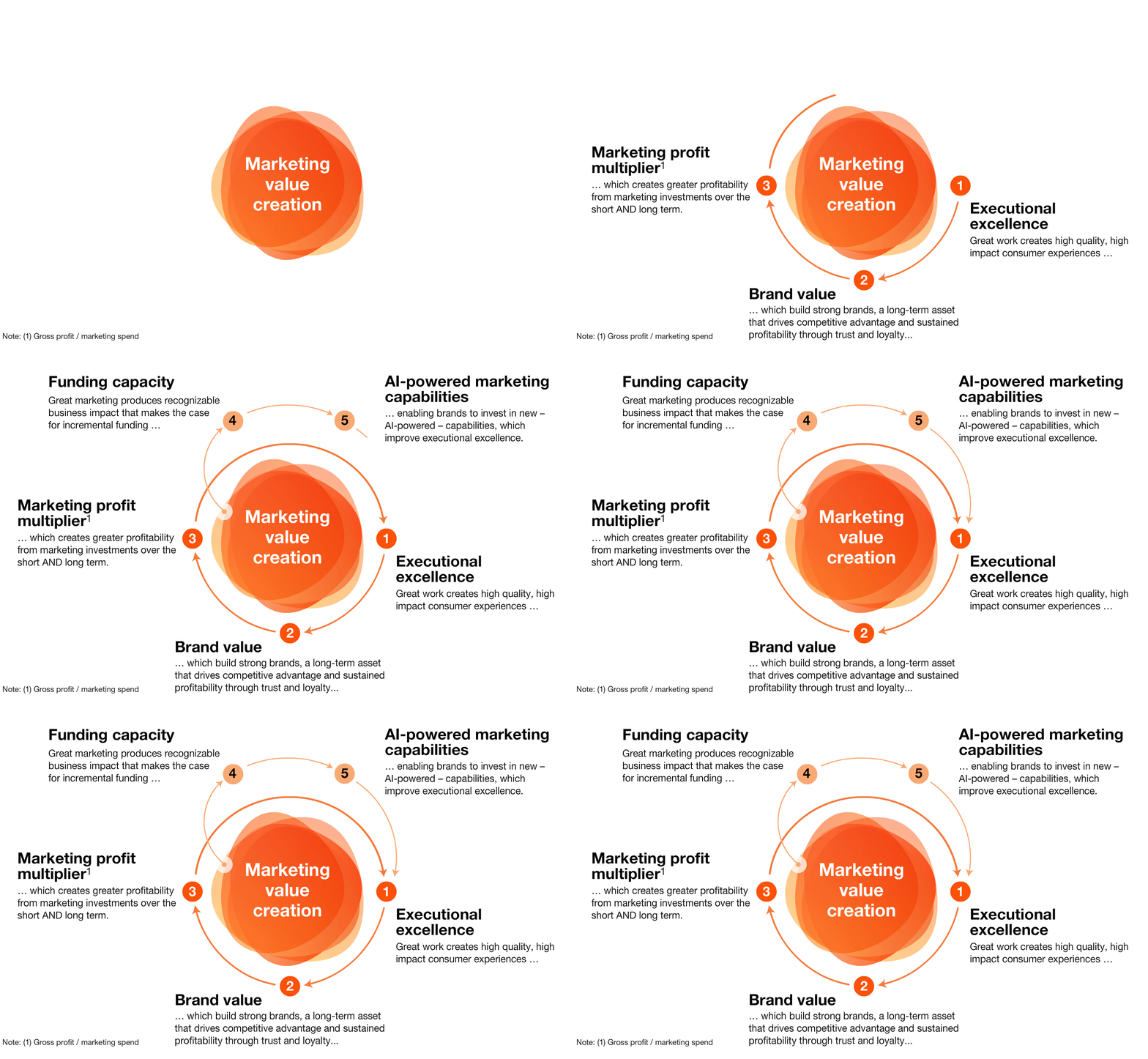
In collaboration with the ANA, we analyzed more than 190 companies across four key analytical tests (comprising five years of data) to determine the impact of marketing on business growth and enterprise value. Drawing on more than 5,000 Cannes Lions awards across nine categories—the first ever use of the industry’s most prestigious dataset to measure creative quality and effectiveness—the analysis adds an unprecedented dimension to understanding the impact of marketing.
We then linked these signals to the tangible value marketing has historically created: $1.3 trillion in brand equity across more than 100 of the world’s most valuable brands, $170 billion in annual marketing investment across 11 sectors and $1.8 trillion in total shareholder return each year.
The evidence points to a simple truth: Excelling across all dimensions of the marketing value creation flywheel (execution, brand and profit) creates a flywheel effect. Leading marketers outperform laggards by 79% in total shareholder value when they activate all three dimensions together. Each contributes individually, but when the entire flywheel spins in sync, it creates a compounding effect that results in outsized returns.
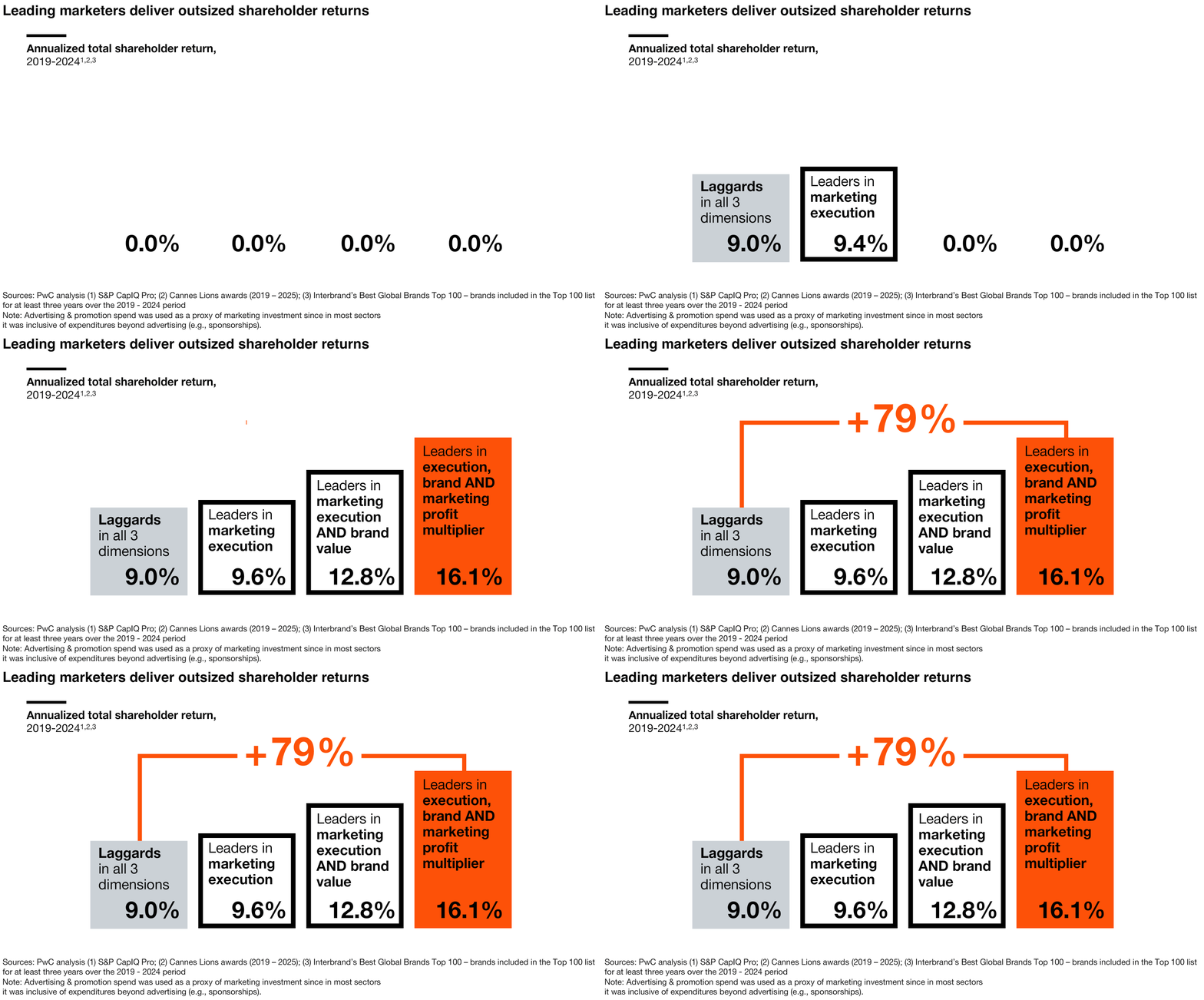
Our analysis included public companies participating in the S&P 500 or NASDAQ 100 augmented with companies with strong marketing signals beyond index participation which had available financial data for the 2019–2024 period.
Leading marketers don’t just outperform their peers. They outperform the market as well. If you could invest in great marketing through a ‘leading marketer ETF’—a weighted portfolio of companies that excel across the marketing value-creation flywheel—you’d see returns that consistently beat the S&P 500 and rival high-performing investment funds. Over the past five years, leading marketers delivered an annualized total shareholder return of 23.3%, outpacing the S&P 500 by 8.8 percentage points.
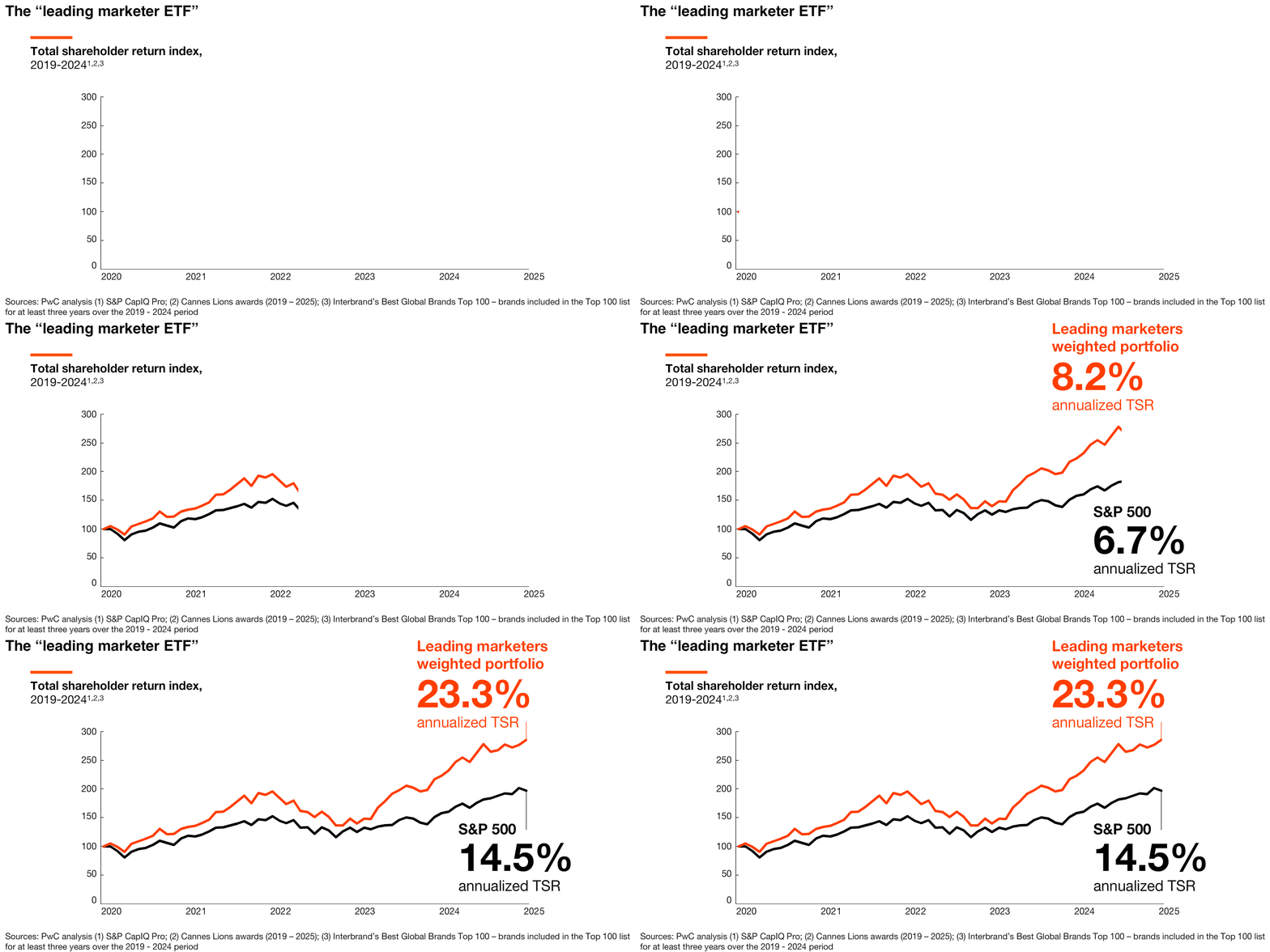
The TSR Index, 2019-2024 was calculated based on the weighted average of leading marketers vs. S&P 500 companies.
It starts with execution excellence—high-quality, high-impact campaigns delivered with precision. Done consistently, great execution builds momentum, reaching the right audiences with the right messages at the right time. Over time, this helps fuel brand strength—a long-term asset that shapes mental availability and preference, strengthens pricing power and builds trust and loyalty.
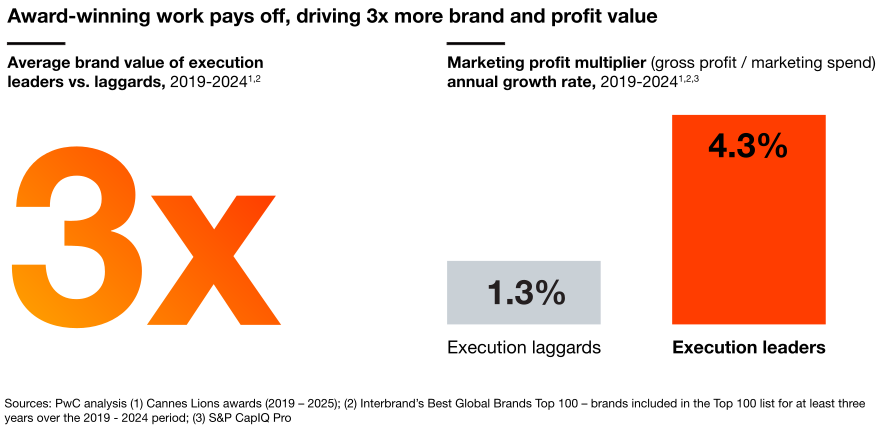
To assess how creative execution affects financial outcomes, we used Cannes Lions awards (2019–2025) as a proxy for creative quality and effect
Strong brands then unlock the marketing profit multiplier (gross profit / marketing spend). They improve margins, drive efficiency and strengthen unit economics. These benefits aren’t marketing’s vanity metrics. They’re visible in the profit and loss (P&L) statement.
This is where the flywheel completes its first loop: Profit growth fuels enterprise value—stronger earnings, improved capital efficiency and superior total shareholder return. But more importantly, that’s not where it ends. The most effective organizations treat shareholder value as a signal to reinvest in new capabilities—like AI—that can drive smarter execution, stronger brands and greater profits. That’s how marketing becomes a self-reinforcing engine of enterprise value creation.
The C-suite pact: From cost debates to growth alliance
Despite this evidence, many CMOs will still face an uphill battle. It’s not enough to point out what leading marketers achieve. You need to demonstrate marketing’s value in your own business. Or, as one executive at a global consumer products company told us, “Marketing’s job is outcomes, not outputs.” That depends on how effectively you connect with your CEO and CFO.
Without clear, intuitive translation into financial language, marketing achievements risk being dismissed as activity, not impact. Spend, not value. Leading CMOs take a different approach. They don’t just report performance. They build trust.
With the CFO, effective CMOs translate marketing-centric metrics like mROI and brand lift, which are often viewed as opaque or ambiguous, into the language of finance to show how marketing drives tangible business growth. They draw a direct line from marketing outcomes to revenue, margin and shareholder value, turning finance into a co-owner of growth rather than a gatekeeper of spending. This trust-based alliance embeds marketing into the financial fabric of the business, allowing marketing investments to be evaluated with the same rigor—and rewarded with the same confidence—as any capital allocation.
With the CEO, great CMOs act as growth strategists, not functional operators. They work with the CEO and align marketing’s narrative to the enterprise agenda. By showing how marketing builds competitive advantage, driving short-term profitability and long-term value, you can secure your role at the center of strategy—with marketing as a growth engine.
Our CMO and CFO interviews helped us understand how they put this into practice. The differences were striking, setting leading marketers apart from the rest. As one senior leader put it, “The goal is clarity, not just more metrics. Every marketing measure must ladder up to business outcomes for marketing to earn its place on the P&L.”
Organizations capture outsized gains from the AI when they adopt it strategically, embed it across the marketing P&L and measure its impact with rigor and intent. A CMO from a Fortune 500 company told us that he expects marketing to be 90% AI-powered by 2027, changing how it creates value for their organization.
And yet there is skepticism around AI’s true impact, challenging the returns AI drives and disruptions on focus and productivity. This caution is healthy. We should scrutinize AI’s business value and recognize that early enthusiasm should be matched with tangible outcomes. Still, you shouldn’t confuse potential execution gaps in initial adoption with technology limitations. As with every transformation wave, value capture often depends less on potential and more on organizational follow-through.
Like past digital revolutions, AI won’t unlock enterprise value simply because of technology. It takes strategic intent and disciplined execution. Early adopters are already breaking through experimentation and moving toward scale. Through our conversations with CMOs and CFOs and our client experience, we see measurable impact today: sharper productivity, accelerated speed to market, greater content velocity and enhanced creative quality—and a new level of real-time accountability to growth.
These proof points are clear. When AI is embedded strategically with well-defined purpose and clear guardrails, it helps deliver improvements across cost, speed, quantity and quality. These gains compound over time, positioning today’s leaders at the forefront of marketing’s next era of growth.
Benefits from AI adoption in marketing within the context of specific use cases and activations
Sources: (1) Interviews with 30 CMOs and CFOs; (2) PwC client experience; (3) ANA AI database
The critical question is whether leaders will treat AI as a cost-cutting tool or embrace it as a growth multiplier.
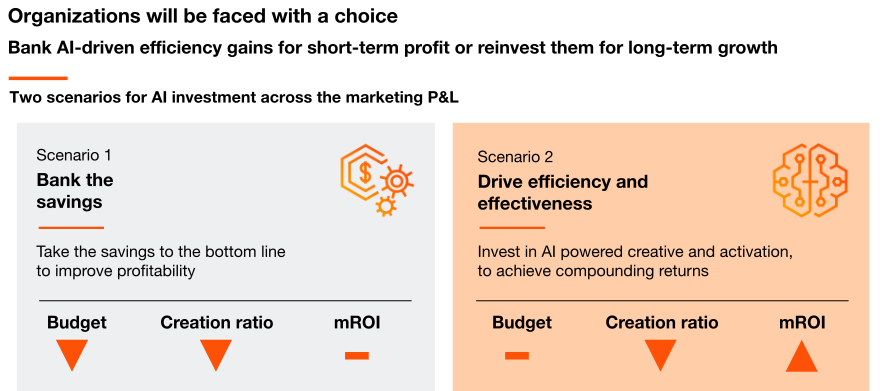
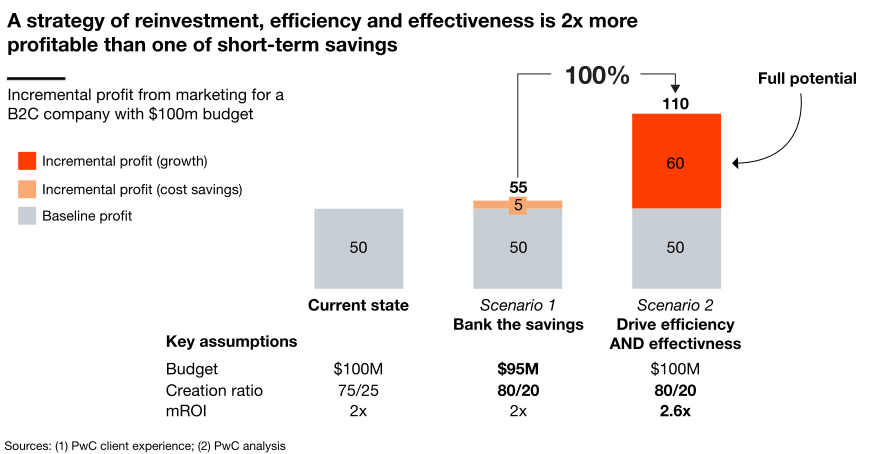
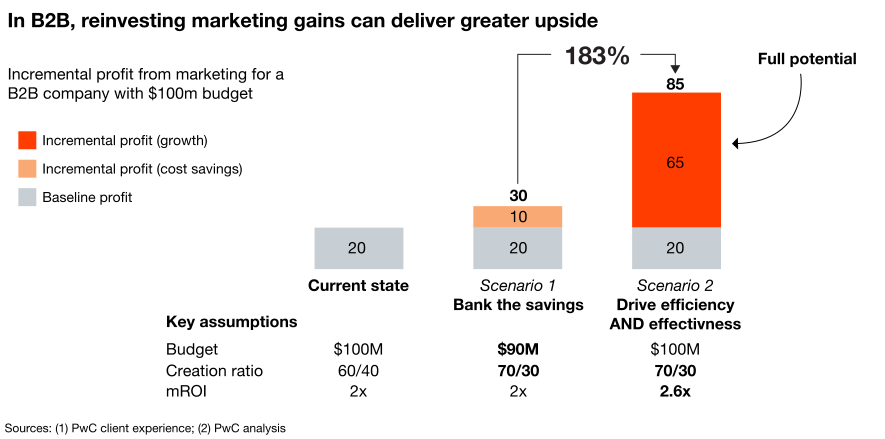
AI can automate tasks that once consumed time and budget, things like content adaptation, segmentation and insights, reporting and measurement, even the origination of new creative concepts. Typically, B2C and B2B marketers have creation ratios—the “making” side of marketing, such as creative ideation, content development, insights and analytics that turn ideas into campaigns—of 20% to 25% and 35% to 40%, respectively. Since AI can unlock meaningful near-term savings, it’s no surprise many CFOs see it as a way to do more with less.
But stopping there is a trap. A CMO at a leading healthcare company warned us: “AI’s biggest gift to marketing isn’t automation. It’s objectivity. It takes waste and bias out of processes and leaves more room for creativity.”
The bottom line may look attractive right now, but banking those savings delivers less long-term benefit. It risks cementing marketing’s role as a cost that needs to be managed rather than elevating it as a growth engine.
AI can help improve and scale creative quality and marketing activation. This includes upfront creative ideation, concept / innovating testing, and prediction of marketing and cultural shifts to enable content to reach audiences effectively and drive measurable performance—from personalized messaging to dynamic content variations tested in real time. Targeting becomes more precise, with predictive analytics guiding who to engage, when and how. Customer journeys can be relevant and personalized end to end, with AI anticipating needs and tailoring offers across channels.
These advances do more than enhance existing campaigns. They open new avenues for growth. For instance, AI-driven insights can identify untapped customer segments, uncover hidden product opportunities or suggest new go-to-market approaches. Just as importantly, they democratize capability. AI gives smaller markets and brands access to the kind of insight, creativity and precision once reserved for those with the biggest budgets, enabling breakthrough marketing at scale. This was evident in our CMO discussions, with one consumer packaged goods executive describing how their teams are already using AI to power a “many-to-many” engagement model.
The real payoff comes when efficiency fuels effectiveness. A strategy of reinvestment that channels efficiency gains into greater effectiveness can be 2x+ more profitable than one focused solely on short-term savings.
Great marketing is the driving force behind outsized shareholder returns. Treating AI as a growth driver instead of just a cost-cutter can further elevate marketing and deliver the biggest returns for your business. A top executive of a global energy company put it best: “Efficiency is the easy part. Real value comes when AI changes how we create and compete.” That shift—from short-term efficiency to long-term effectiveness—can set leaders apart. It also underscores the need for clear, evidence-based communication across your organization so other C-suite leaders can grasp the long-term value of marketing investments.
CMOs in collaboration with CFOs and CEOs must decide whether AI is a lever for this quarter’s margin or a catalyst for the next decade’s growth. Our analysis shows that marketing can be a repeatable engine of value creation. Execution fuels brand strength, strong brands unlock the marketing profit multiplier (gross profit / marketing spend), and that helps drive enterprise returns.
AI doesn’t change that equation. It advances it. As a marketing leader, you have a window—and a mandate—to show the boardroom how AI can strengthen the flywheel. But that window won’t stay open forever.
Post a Comment